WY-01-02 / 02
Strategic Interaction: Participants’ Objectives, Choices, and Constraints
First Principles
Sam Rivera
Lesson / WY-01-02
Actual institutions are participants with legal identities, investment objectives, and execution rules. They may trade directionally, hedge, track indices, provide liquidity, or conduct cross-market arbitrage. Different institutions can have opposing horizons, risk limits, and interests, and any bar may contain several kinds of activity. A “holder” is not necessarily a directional speculator: a sale may come from a bearish trader, a physical producer’s hedge, a market maker reducing inventory risk, or one leg of an arbitrage portfolio.
The course video is not yet available. This interface demo uses a separate MT animation, not the lesson video.
Read the Chapter ↗Demo timestamps
8 lessons · Chapter contents
01Meaning and Purpose of the Composite Operator↗02Strategic Interaction: Participants’ Objectives, Choices, and Constraints↗03Building, Holding, and Reducing Positions: What Is Visible↗04“Major Operators’ Intentions” as a Candidate Explanation↗05Observable Information and Inference↗06Replacing Speculation about Major Operators with Testable Conditions↗07Applying the Model across Markets↗08Updating Composite Operator Scenarios with Evidence↗The course transcript will be available with the finished video. The captions below belong to the interface demo.
Observe the market: start with context and place price within its structure.
Understand structure: compare supply and demand, and let evidence support or revise your hypothesis.
Form a view: define risk limits and know when to reassess.
No matching captions.

What the Wyckoff Method Studies
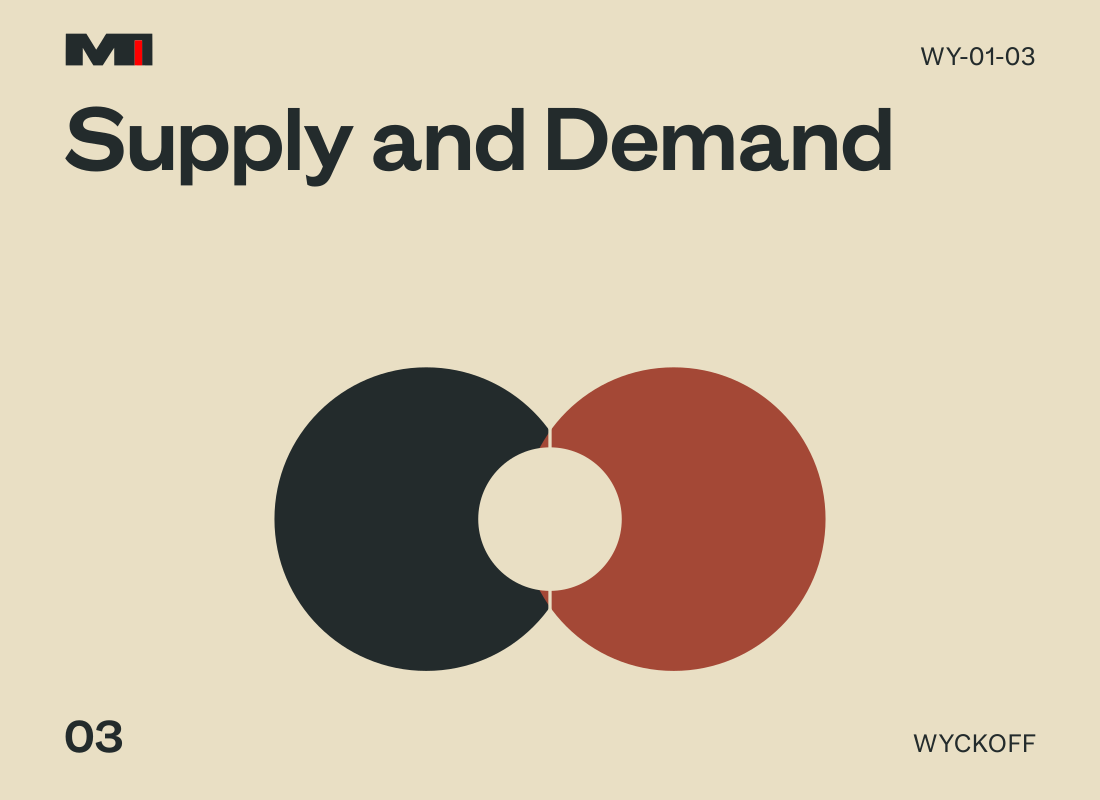
The Law of Supply and Demand: Understanding Price Changes